"Can we create new life out of our digital universe?" asks Craig Venter. And his answer is, yes, and pretty soon. He walks the TED2008 audience through his latest research into "fourth-generation fuels" -- biologically created fuels with CO2 as their feedstock. His talk covers the details of creating brand-new chromosomes using digital technology, the reasons why we would want to do this, and the bioethics of synthetic life
Sunday, July 10, 2011

Wednesday, June 29, 2011
Lung Cardiac and Colon Screening with CT
CT scanning, also called CAT scanning, is a noninvasive medical test that helps physicians diagnose and treat medical conditions. Drs. Fergus Coakley, Brett Elicker, and Judy Yee, UCSF Department of Radiology, explore the risks and benefits of lung, heart and colon screenings with CT.
Thursday, June 16, 2011
Multilevel Interventions in Health Care Conference
Multilevel Interventions in Health Care: Building the Foundation for Future Research Goals, with his background as an oncologist, researcher and administrator, Dr. Otis Brawley (American Cancer Society) brings his unique perspective on multilevel interventions in clinical practice and consider how health care changes and multilevel interventions. Dr. Brawley currently serves as professor of hematology, oncology, medicine and epidemiology at Emory University. From April of 2001 to November of 2007, he was medical director of the Georgia Cancer Center for Excellence at Grady Memorial Hospital in Atlanta, and deputy director for cancer control at Winship Cancer Institute at Emory University. He has also previously served as a member of the Society’s Prostate Cancer Committee, co-chaired the U.S. Surgeon General’s Task Force on Cancer Health Disparities, and filled a variety of capacities at the National Cancer Institute (NCI), most recently serving as assistant director.
Monday, June 6, 2011
The Evolution of the p53 Family of Genes: Somatic Cell & Germ Cell Fidelity
Arnold J. Levine, The Simons Center for Systems Biology, Institute for Advanced Study. Arnold Levine is a widely acclaimed leader in cancer research. In 1979, Levine and others discovered the p53 tumor suppressor protein, a molecule that inhibits tumor development. He established and heads the Simons Center for Systems Biology at the Institute, which concentrates on research at the interface of molecular biology and the physical sciences: on genetics and genomics, polymorphisms and molecular aspects of evolution, signal transduction pathways and networks, stress responses, and pharmacogenomics in cancer biology.
Saturday, May 28, 2011
Focusing Genomics on Human Genetics
Richard Gibbs talk about genomics, and sequencing genome, he received a B.Sc.(Hons) in 1979 and a Ph.D. in Genetics and Radiation Biology in 1985 at the University of Melbourne, Melbourne, Australia. He subsequently moved to Houston as a Postdoctoral Fellow at Baylor College of Medicine to study the molecular basis of human X-linked diseases and to develop technologies for rapid genetic analysis. During this period, he also developed several fundamental technologies for nucleic acid analysis. In 1991, he joined the faculty at BCM and played a key role in the early planning and development phases of the International Human Genome Project. In 1996, he established the Human Genome Sequencing Center (HGSC) when Baylor was chosen as one of six worldwide sites to complete the final phase of the project. He currently holds the rank of Director and Professor.
Sunday, May 22, 2011
Professor Alexander Meisels visit to Bucaramanga, Colombia
In way to improve the biomedial research the Professor Alexander Meisels visit Bucaramanga Colombia. Born in Berlin, Germany, he received his early schooling in Paris,France, and later attended the National University of Mexico, where he obtained his B.Sc. and M.D. He specialised first in diagnostic cytology at the National Cancer Institute of Mexico and later in pathology atLaval University, Quebec, Canada. He became Assistant Professor of Pathology and Head of the Cytodiag nostic Laboratory at LavalUniversity in 1960, where he also founded the School ofCytotechnology. Named Associate Professor in 1965, he became a Full Professor in 1968.In 1970 he was named Head of Cytopathology at the CHA (Centre hospitalier affilié with Laval University) in Quebec City with an annual volume of about 160,000 cytology specimens. From 1978 to 1995 he was Head of the Department of Anatomic Pathology and Cytology at the same institution. The School of Cytotechnology“Alexander Meisels” functioned within that Department and was part of the course in Medical Technology of the Sainte‑Foy College until 2001.He is certified in Anatomic Pathology by the Quebec Corporation of Physicians and Surgeons, the Royal College of Physicians and Surgeons of Canada and the American Board of Pathology.Treasurer and Past-President of the International Academy of Cytology, previously Secretary‑Treasurer of the IAC (1971‑1986), twice President of the Canadian Society of Cytology (1966-1967 and 1978-1979), President of the Canadian Association of Pathologists (1988‑1989), and President of the American Society of Cytopathology (1991-1992). Secreta ry or President of six International Congresses of Cytology (Miami 1974, Tokyo 1977, Munich 1980, Montreal 1983, Brussels 1986, Buenos Aires 1989). He is Editor of ACTA CYTOLOGICA and member of the Editorial Board of Cytojournal and of Cancer Cytopathology, member or honorary member of many natio nal and international scientific societies. He is the author of over 140 publications in the field of cytopathology and cancer, including books:Cytopathology of the Uterine Cervix (ASCP Press, Chicago, 1991),Cytopathology of the Uterus (ASCP Press, 1997) and Modern Uterine Cytopathology (ASCP Press 2006).


Thursday, May 19, 2011
Anticipating the Next Decade of the Genome - Francis Collins, Director of NIH
A Decade with the Human Genome Sequence: Charting a Course for Genomic Medicine
NHGRI hosted a day-long scientific symposium on Friday, Feb. 11, at the Ruth L. Kirschstein Auditorium, Natcher Conference Center on the National Institutes of Health (NIH) campus. The goal of the symposium was to offer the NIH community an exciting glimpse into contemporary genomics research, illustrating how genomics can be used to further medical discoveries and how genomics relates to individuals, communities and societies
NHGRI hosted a day-long scientific symposium on Friday, Feb. 11, at the Ruth L. Kirschstein Auditorium, Natcher Conference Center on the National Institutes of Health (NIH) campus. The goal of the symposium was to offer the NIH community an exciting glimpse into contemporary genomics research, illustrating how genomics can be used to further medical discoveries and how genomics relates to individuals, communities and societies
Monday, May 16, 2011
David Argyle - Hounds and the Cancer Genes:
The final in a series of public lectures which show that keen detective work is still essential for 21st Century doctors.
Recorded on 19 November 2009 in the Anatomy Lecture Theatre at the University of Edinburgh.
Inspired by Sir Arthur Conan Doyle, the lectures highlight the University's acclaimed medical research.
The speaker, David Argyle, is William Dick Professor of Veterinary Clinical Studies at the University.
Recorded on 19 November 2009 in the Anatomy Lecture Theatre at the University of Edinburgh.
Inspired by Sir Arthur Conan Doyle, the lectures highlight the University's acclaimed medical research.
The speaker, David Argyle, is William Dick Professor of Veterinary Clinical Studies at the University.
Saturday, May 7, 2011
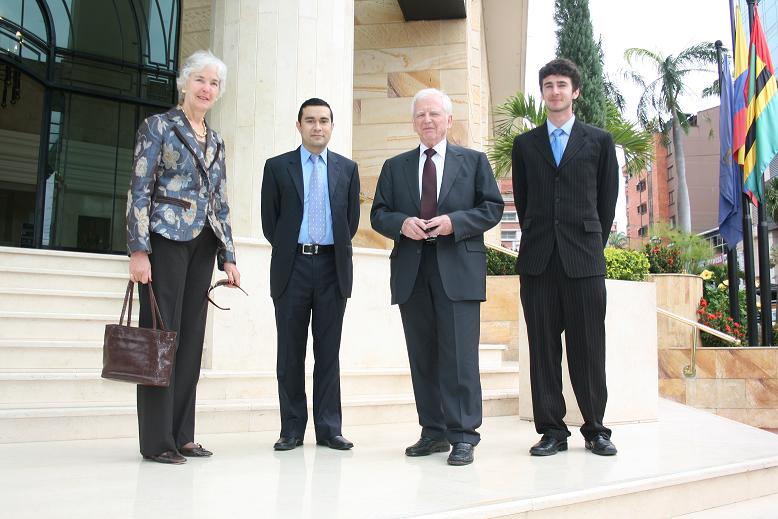
Professor zur hausen, Professor de Villiers and me
The visit to Bucaramanga Colombia by the Professors Harald zur Hausen, Professor Ethel Michelle de Villiers and Professor Alexander Meisels, a new strategy to boost cancer research in Colombia.




Breast Cancer Medicine: Today and Tomorrow
Medical oncologist Larry Norton of Memorial Sloan-Kettering Cancer Center explains how new information about the biology of breast cancer is paving the way for a more targeted approach to chemotherapy for breast cancer. Advances in the field of molecular genetics have shown that breast cancer can be caused by several genetic mutations. Researchers are using this information to develop more effective therapies that target these genes.
Subscribe to:
Posts (Atom)