The final in a series of public lectures which show that keen detective work is still essential for 21st Century doctors.
Recorded on 19 November 2009 in the Anatomy Lecture Theatre at the University of Edinburgh.
Inspired by Sir Arthur Conan Doyle, the lectures highlight the University's acclaimed medical research.
The speaker, David Argyle, is William Dick Professor of Veterinary Clinical Studies at the University.
Monday, May 16, 2011

Saturday, May 7, 2011
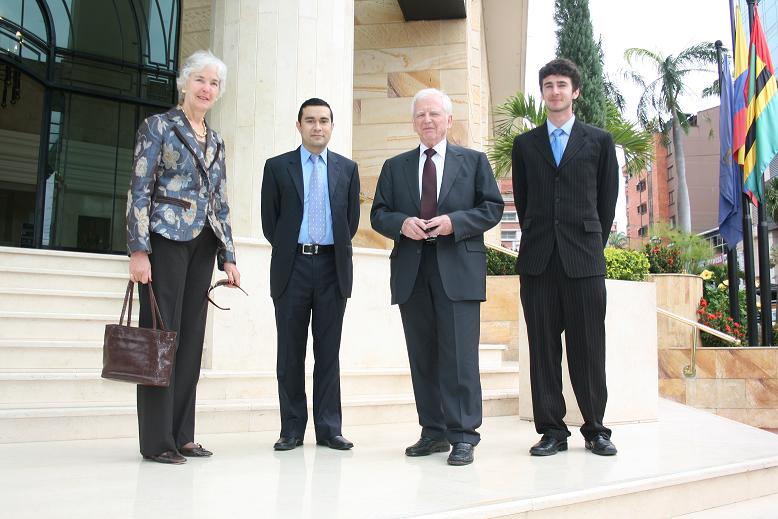
Professor zur hausen, Professor de Villiers and me
The visit to Bucaramanga Colombia by the Professors Harald zur Hausen, Professor Ethel Michelle de Villiers and Professor Alexander Meisels, a new strategy to boost cancer research in Colombia.




Breast Cancer Medicine: Today and Tomorrow
Medical oncologist Larry Norton of Memorial Sloan-Kettering Cancer Center explains how new information about the biology of breast cancer is paving the way for a more targeted approach to chemotherapy for breast cancer. Advances in the field of molecular genetics have shown that breast cancer can be caused by several genetic mutations. Researchers are using this information to develop more effective therapies that target these genes.
Monday, April 11, 2011
Molecular Testing in Breast Cancer: Will it Become Standard Practice?
How has gene expression profiling impacted the way we diagnose and treat breast cancers? Kimberly Allison, MD, Assistant Professor, Department of Pathology at the University of Washington discusses how research using gene expression signatures have been used to identify specific subtypes of breast cancer and how these are integrated into traditional classification schemes. In addition, we will explore the development of clinically available gene expression array-based tests that are designed to give prognostic and predictive information tailored to individual breast cancer patients and discuss current limitations of these tests
Saturday, April 2, 2011
Chronic Lymphocytic Leukemia
Chronic Lymphocytic Leukemia (CLL) is the most common form of leukemia found in adults in the Western world. Leading CLL researcher Dr. Thomas Kipps discusses the latest in the course of the disease including: symptoms, causes, and risk factors. Dr. Kipps also highlights discoveries made in his lab that may lead to developing new therapies to treat this disease.
Tuesday, March 29, 2011
Global Inequalities implications for research, practice and policy
Michael Marmot was born in London, England. He moved to Australia as a young child and graduated in Medicine from the University of Sydney, Australia, in 1968. He earned a MPH in 1972 and PhD in 1975 from the University of California, Berkeley. He became Fellow of the (English) Faculty of Public Health Medicine in 1989 and was appointed Professor of Epidemiology and Public Health at UCL in 1985. This became a joint Chair, held at UCL and the London School of Hygiene and Tropical Medicine, in 1990. He became Director of the International Centre for Health and Society (now the International Institute for Society and Health) that he established at UCL in 1994. He was a member of the Royal Commission on Environmental Pollution and awarded an MRC Professorship in 1995. He was elected as a Fellow of the Royal College of Physicians in 1996. In 2004 he was awarded the Balzan Prize for Epidemiology. He was Chair of the WHO Commission on Social Determinants of Health from 2005 to 2008.
Monday, March 28, 2011
Skin Cancer Prevention and Early Detection
Skin cancers -- including basal cell carcinoma, squamous cell carcinoma, and melanoma -- are on the rise, but using sunscreen liberally and limiting exposure to the sun can help prevent them, says Isaac Brownell of Memorial Sloan-Kettering Cancer Center. Regular self-examination of your skin, including a yearly dermatology checkup, is the best way to identify skin lesions that may be cancerous. Diagnostic tools such as dermoscopy and confocal microscopy provide detailed images of skin lesions, which may help detect skin cancers and avoid unnecessary biopsies of non-cancerous lesions.
Monday, March 21, 2011
Molecular Assays for Colorectal Cancer Care
Molecular assays for risk stratification for cancer and for the early detection of cancer are currently being developed and are beginning to be used in clinical care. Likewise, molecular assays are being developed as predictive and prognostic markers for cancer. The state-of-the art of currently available risk stratification assays and molecular screening assays for colorectal cancer will be discussed. Current developments in the generation of predictive and prognostic markers for colorectal cancer will also be discussed. Finally, future directions for molecular assays for colorectal cancer will be reviewed.
Sunday, March 13, 2011
Saturday, March 5, 2011
Using Dendritic Cells to Create Cancer Vaccines
Edgar Engleman, MD, medical director of the Stanford Blood Center, discusses his research involving the use of a special type of white blood cell as a treatment for cancer. Engleman, who is also a professor of pathology at the Stanford School of Medicine, and his team of researchers have been interested in dendritic cells, or DCs, which can provoke an immune response in the body
Subscribe to:
Posts (Atom)